
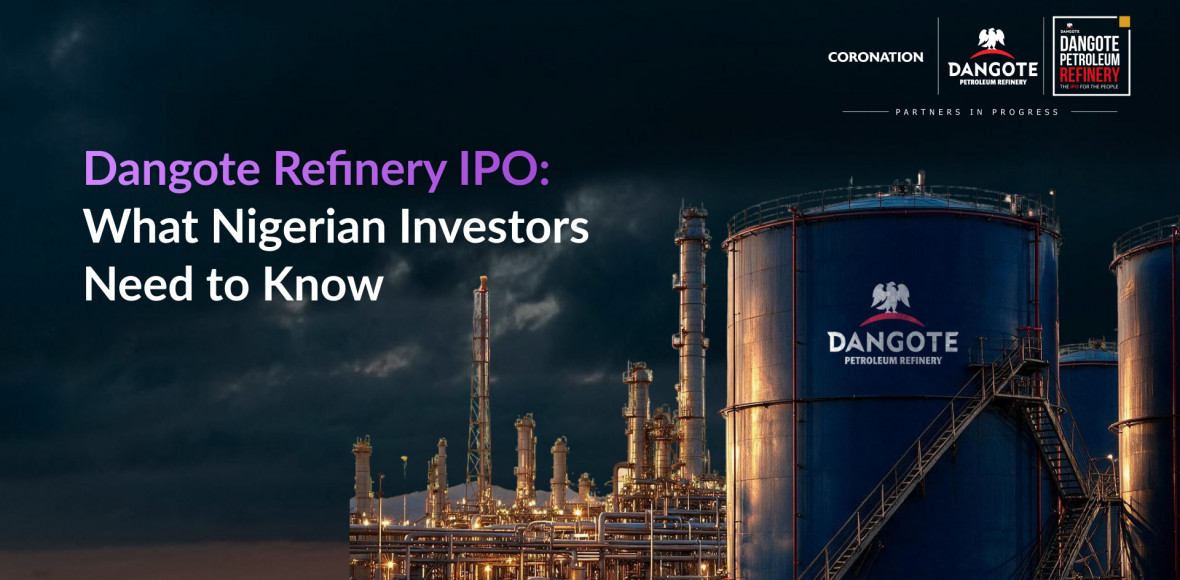
The Dangote Refinery has been one of Nigeria’s biggest industrial ambitions, a refinery built to transform how the country produces, supplies and exports refined petroleum products.
Now, that ambition is taking another important step.
On Monday, September 7, 2026, the Dangote Refinery IPO signing ceremony officially took place at Eko Hotel and Suites in Victoria Island, Lagos, marking a significant milestone in the company’s journey to becoming publicly owned. Through the offer, scheduled to open on the 14th of September, 2026, 4.1 billion ordinary shares will be made available to the investing public at ₦525 per share, putting the total deal value at approximately ₦2.15 trillion ($1.6 billion).
For everyday Nigerian investors, however, the headline figure is not the only thing worth paying attention to. The minimum subscription is 10 ordinary shares, meaning investors can participate with ₦5,250. That makes the offer accessible to a much wider pool of Nigerians who may want to own a stake in the Dangote refinery.
But accessibility does not mean investors should rush in blindly.
Before putting down your ₦5,250 or a much larger amount, it is worth understanding what you are buying, how the IPO works, the opportunities the refinery presents, and the risks that come with owning the shares.
So, what exactly should Nigerian investors know about the Dangote Refinery IPO?
First, what is an IPO?
An Initial Public Offering, or IPO, is simply the process through which a private company offers shares to the public for the first time.
Think of it as a company opening the doors of ownership to a much larger group of investors.
Before an IPO, ownership is generally concentrated among founders, private investors and institutions. After the IPO, members of the public can buy shares and become shareholders themselves.
That means the Dangote Refinery IPO is not simply another investment product. It is an opportunity to take direct equity ownership in the refinery business.
And that distinction matters.
Why is the Dangote Refinery IPO such a big deal?
The refinery is not an ordinary company.
Located in Lagos, the Dangote Refinery was built at an estimated cost of about $20 billion and has a stated processing capacity of 650,000 barrels of crude oil per day.
Nigeria has historically depended heavily on imported refined petroleum products despite being one of the world’s major crude oil producers. A large-scale domestic refinery therefore has implications for fuel supply, foreign exchange demand, exports and the wider Nigerian economy.
That gives the company an unusually large addressable market.
But a large market does not automatically make a good investment. Investors still have to examine the company’s earnings, valuation, risks and future growth prospects.
How much will Dangote Refinery shares cost?
The Dangote Refinery IPO is offering 4.1 billion ordinary shares at ₦525 per share, for a total value of approximately ₦2.15 trillion ($1.6 billion).
But another figure may catch the attention of everyday investors: ₦5,250.
That is because the minimum subscription is 10 ordinary shares, meaning an investor can participate in the IPO with as little as ₦5,250.
For many Nigerians, this makes the offer considerably more accessible. You do not need millions of naira to own a small stake in one of the country’s biggest industrial businesses.
Of course, investors can subscribe for more than the minimum 10 shares, depending on the terms of the offer and their available funds.
So, if you are considering participating, the starting point is simple: ₦5,250 gets you 10 shares at the offer price of ₦525 each.
The bigger question of what those shares could be worth in the future is a different conversation, and one investors should consider carefully before deciding how much to put into the IPO.
What will the IPO money be used for?
One of the biggest attractions is the refinery’s expansion plans.
Dangote has indicated plans to increase refining capacity to approximately 1.4 million barrels per day, effectively more than doubling its current capacity. The IPO is expected to help provide capital for this expansion, alongside other sources of funding.
That creates an interesting investment proposition.
Investors are not simply buying into what the refinery is today. They are also buying into what management believes the business can become.
If the expansion is executed successfully, higher capacity could mean greater production, increased revenue, and potentially stronger profitability.
But the word “potentially” is doing some heavy lifting there.
Large industrial projects come with execution risks, funding requirements, operational challenges, and changing market conditions.
What could make the investment attractive?
There are several factors investors may find compelling.
First is scale. Dangote Refinery is already one of the largest single-train refineries in the world; this gives it a significant position in regional energy markets.
Second is domestic demand. Nigeria consumes substantial quantities of petrol, diesel and aviation fuel, while the refinery also has ambitions to serve export markets.
Third is export potential. The refinery has already become an important supplier of refined products beyond Nigeria. Exports of significant volumes mean the business has an opportunity to earn foreign exchange.
Fourth is the planned expansion.
If management succeeds in increasing capacity while maintaining healthy margins, the company’s earnings potential could grow considerably.
What Are the Risks?
The refinery’s size and profile may make the IPO attractive, but it does not make the investment risk-free. Like any equity investment, investors should understand the risks before committing their money.
1. Valuation Risk
Recent private transactions have implied a valuation of around $40 billion, while earlier reports had placed the potential valuation even higher.
This means investors need to consider whether the IPO price fairly reflects the company’s current performance and future earnings potential. A strong business can still be a poor investment if investors pay too much for it.
2. Crude Oil Supply Risk
A refinery cannot operate without crude oil to process.
While the Dangote Refinery has access to domestic crude and has also sourced crude internationally, securing sufficient crude at competitive prices remains an important consideration. Higher feedstock costs could put pressure on the refinery’s margins and, ultimately, its profitability.
3. Oil Price and Refining Margin Risk
The profitability of a refinery depends partly on the difference between the cost of crude oil and the price it can sell refined petroleum products for.
These refining margins can move up or down depending on crude oil prices, global fuel demand, supply conditions and geopolitical developments. A period of weaker refining margins could therefore affect the company’s earnings.
4. Expansion and Execution Risk
Dangote Refinery has ambitious plans to increase its capacity to 1.4 million barrels per day.
That expansion could create significant opportunities for future growth, but delivering a project of this scale also comes with risks. Delays, higher-than-expected costs, operational challenges or difficulties in securing the necessary funding could affect the company’s plans and financial performance.
5. Market and Regulatory Risk
The refinery operates in an industry that is closely connected to government policy and regulation.
Changes in regulations, petroleum pricing policies, taxes, import rules or other government interventions could affect the company’s operating environment. Changes in global energy markets could also influence demand and profitability.
Ultimately, the Dangote Refinery story has significant growth potential, but investors should remember that potential and performance are not the same thing. Understanding these risks is just as important as understanding the opportunities before deciding to invest.
How can Nigerian investors participate?
The most important rule is simple: use official channels.
The Securities and Exchange Commission previously warned investors about unauthorised marketing of purported Dangote Refinery shares and specifically cautioned against paying money to anyone promising guaranteed allocations before an approved offer was available.
That warning matters because an IPO generating this much public interest will inevitably attract opportunists.
Before applying, investors should confirm the final SEC-approved prospectus, subscription dates, minimum investment, payment instructions and the identity of authorised capital market operators handling the offer.
Do not send money because someone on WhatsApp or any channel says they can “secure” your allocation.
An IPO is an investment opportunity, not a lottery ticket.
This is where working with an established stockbroker such as Coronation Securities can make the process easier.
Coronation Securities is an active SEC-registered broker/dealer, according to the SEC’s registered-operator directory. As part of the Coronation Group, the firm provides investors with access to the Nigerian capital market and can help investors understand and participate in investment opportunities such as public offers, subject to the terms and approved documentation of the offer.
Is this the right investment for you?
There is no universal answer.
For some investors, the IPO could provide exposure to a major Nigerian industrial business with significant growth ambitions.
For others, the valuation, concentration risk or exposure to the energy sector may make it unsuitable.
The right question is therefore not “Will Dangote Refinery make me money?”
It is “Does this investment fit my financial goals, risk tolerance and portfolio?”
That is a much better question because investing is ultimately about probabilities, not promises.
The Dangote Refinery IPO could become one of the defining transactions in Nigeria’s capital market history. But its significance should not distract investors from the fundamentals.
Read the prospectus. Study the numbers. Understand the risks. Consider your investment horizon.
Then, and only then, decide whether you want to become a shareholder.
Because when the excitement surrounding the IPO eventually fades, investors will be left with something much more important than the headlines: a stake in a real business, whose performance will ultimately determine the value of their investment.
Related Posts
What to Look for in a Digital Investment Platform

The number of Nigerians investing through digital platforms has grown significantly in recent years. Lower barriers to entry, mobile-first experiences Read more
Treasury Bills vs FGN Bonds: Choosing the Right Investment Strategy
Nigerian fixed-income markets are offering some of the most attractive yields in recent memory. With Treasury Bill stop rates at Read more
Why Investors Buy High and Sell Low: Behavioural Finance Explained

Most investors know the principle: buy low, sell high. Yet across markets and generations, the opposite pattern repeats. Investors buy Read more
Designing the Shareholder Journey: From Friction to Delight

In this episode of the Coronation Registrars Podcast Series, host Abdulfatai Juwon is joined by Oluwanifemi Adeyeye, Operations Analyst at Coronation Registrars, to Read more