
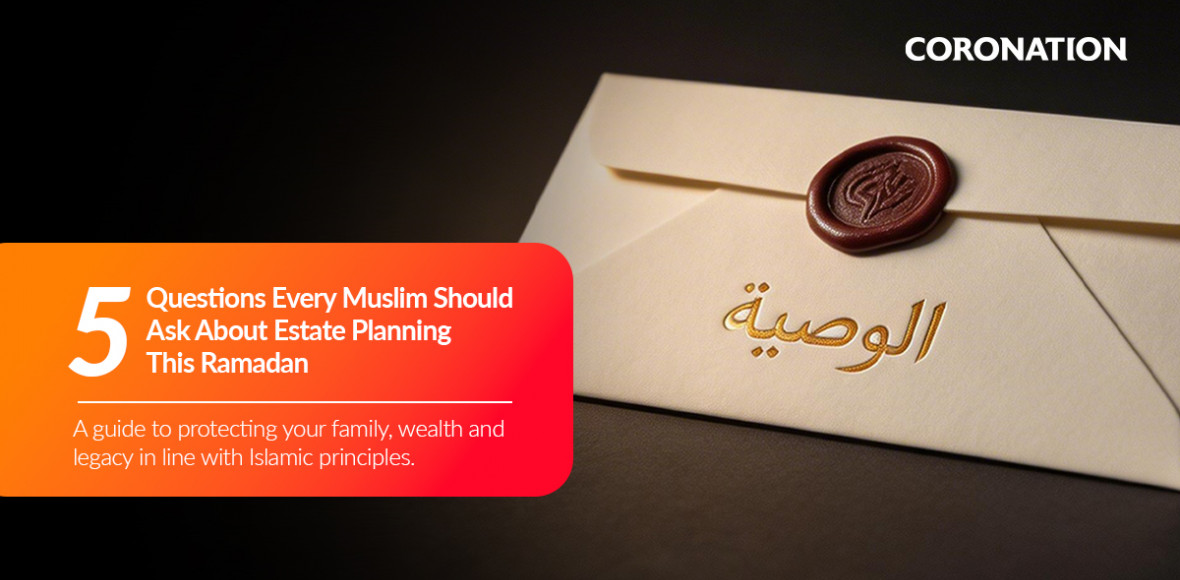
Ramadan provides an ideal moment to pause and consider an important question: Is my estate arranged in a way that honours both my faith and my family?
Islam treats wealth as a trust from Allah. It is something to be managed responsibly during life and distributed justly after death. The principles of Sharia-compliant inheritance (Faraid) provide clear guidance on how estates should be handled.
Therefore, this is an important responsibility every Muslim must uphold.
We have carefully compiled 5 questions that every Muslim should ask to ensure they remain true to this responsibility. Read on to learn more.
Islam provides a structured inheritance system through Faraid, which specifies how assets should be distributed among heirs, including spouses, children, and parents. This mode of distribution should be done as divinely prescribed to demonstrate that you respect your faith.
However, without proper estate-planning structures, estates can be delayed in legal proceedings or distributed in ways that do not reflect Islamic principles.
A Sharia-compliant will or Islamic trust helps ensure that:
The Prophet (SAW) reminded believers:
“It is not permissible for any Muslim who has something to will to stay for two nights without having his last will and testament written and kept ready with him”
(Sahih al-Bukhari)
Estate planning, therefore, becomes an act of faithfulness, not merely a financial arrangement.
An estate cannot be properly administered if the assets within it are unclear. Many families discover after a loved one passes that accounts, properties, or investments were never fully documented.
Clarity does prevent confusion.
To avoid this confusion, consider preparing a simple record that lists:
Islam places strong emphasis on transparency in financial matters. The Qur’an states:
“O you who believe, when you contract a debt for a specified term, write it down.”
(Qur’an 2:282)
The wisdom applies broadly: documentation protects everyone involved.
One of the remarkable features of Islamic estate planning is the opportunity to extend one’s good deeds beyond life.
Through a charitable bequest, a portion of one’s estate may be directed toward causes such as:
This form of giving, Sadaqah Jariyah, continues to generate reward long after a person has passed away.
As the Prophet (SAW) said:
“When a person dies, their deeds come to an end except for three: ongoing charity, beneficial knowledge, or a righteous child who prays for them.”
(Sahih Muslim)
Ramadan, known for generosity, offers a natural moment to consider how one’s estate might support meaningful causes.
Even when assets are substantial, the absence of clear instructions can leave families struggling.
Important questions include:
Naming a trusted executor or trustee helps ensure that the estate is administered responsibly and in accordance with both legal and Islamic requirements.
A well-prepared estate plan removes uncertainty during a time when families should be focused on remembrance and prayer.
Islam encourages believers to leave their affairs organised. Organising one’s affairs reflects accountability before Allah and demonstrates administrative discipline.
Estate planning is a significant part of responsible stewardship. Wealth accumulated over a lifetime should move forward in a manner that upholds fairness, supports family members, and contributes to society.
Ramadan encourages believers to reflect not only on daily actions, but also on the long-term impact of those actions. This may be achieved by taking the
Ramadan is a season of intention. Muslims must renew their commitments to prayer, charity, discipline, and responsibility.
Estate planning sits naturally within that spirit. It ensures that wealth is managed in a way that honours faith, protects family members, and allows charitable impact to continue beyond one’s lifetime.
Take time this Ramadan to create an estate plan that will set you on a path of obedience and accountability.
Contact Coronation Trustees today to learn how we may serve you on this journey of stewardship.
Call us: 0201-227-1720
Email us: trustee@coronationnt.com

When interest rates start falling, the biggest opportunities are often already in motion. Yet many investors make the same mistake; Read more

For most young professionals in Nigeria, income feels predictable. Salary comes in, expenses go out, and whatever is left is Read more
Life insurance is one of the most talked-about financial tools and yet one of the most misunderstood. For many Nigerians, Read more

At some point, everyone pauses to think about the future. Not just the exciting parts like career growth or new Read more